Resilient by Design: OPAL Wins California Passive House Challenge
OPAL has been awarded first prize in the Contemporary category of the California Rebuilds Design Competition, hosted by Passive House Network and Passive House California. The competition underscored the urgent need, and tremendous opportunity, to advance high-performance, fire-resilient housing in communities impacted by our changing climate.
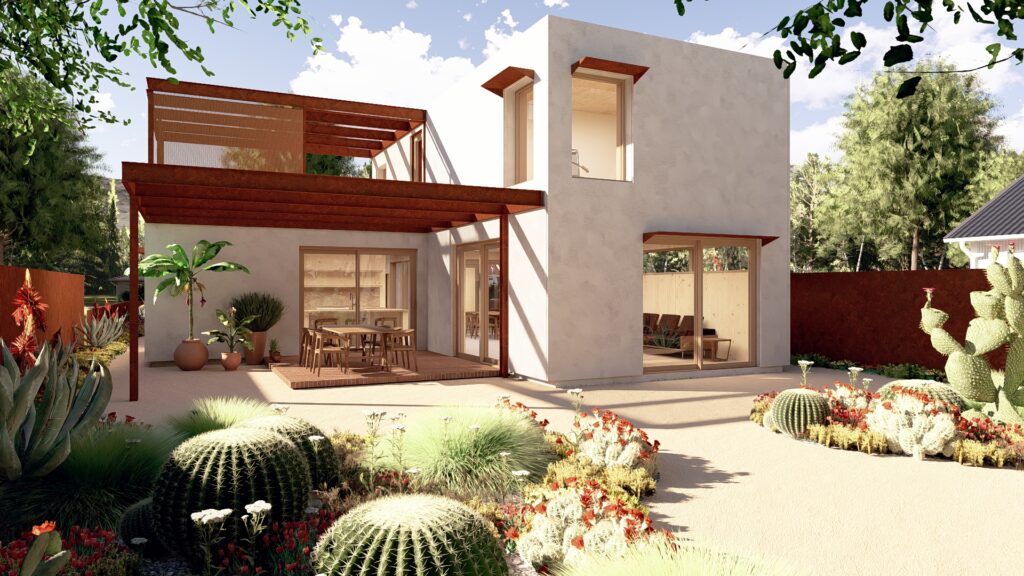
Our design responds directly to the destruction wrought by recent wildfires in Los Angeles. This residence is a compact, replicable model that is optimized for rapid deployment. It is standardized for prefabrication, long-term durability, and minimal environmental impact, including the capacity to be self powered in an emergency, and easily deconstructed. The home’s envelope, biogenic material palette, and Passive House performance metrics are all part of an integrated system focused on sustainability and resilience.
We are grateful to the organizers and jury for recognizing our approach, and to AIA Los Angeles and the broader Passive House community for continuing to push the boundaries of what’s possible. The disaster of the January 2025 fires is a reminder of the fragility of our built environment, of the stark gradient between our climate and our shelters. We remain optimistic about the power of resilient and responsive design to reimagine our building’s role in our ecology. Read more about the design below!

Project Narrative
This prototype home is designed as a high-performance, fire-resilient, and rapidly deployable solution for communities in California’s fire-prone regions. Developed for an infill site in Altadena, a suburb of Los Angeles recently impacted by the Eaton Fire, the home embodies Passive House principles adapted to the challenges and climate of southern California. With a compact 3-bedroom, 3-bath, two-story layout, the design balances energy efficiency, affordability, and replicability—offering a viable path forward for homeowners rebuilding after fire loss.
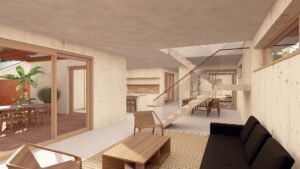
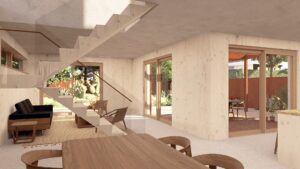
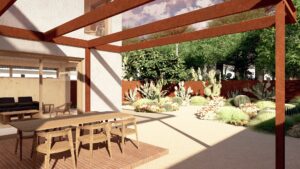
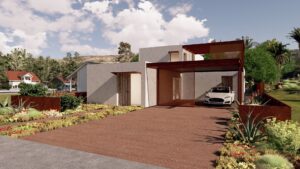
Designed for a typical small lot (48’X124’), the home creates and wraps around a series of partially enclosed outdoor spaces which include the carport (satisfying the parking requirement), a water garden, a generous patio adjacent to the primary living spaces, and a roof terrace. These spaces are sheltered by a system of weathering steel frames and perforated steel panels that provide privacy, shading, and durability as a non-combustible, recyclable material requiring no additional finish. The interior spaces are based on a functional 16’X16’ module that optimizes CLT panelization and allows for customization and adaptation.
At the heart of the project is a commitment to low energy demand and long-term resilience. The design proposes an off-site construction strategy with a building shell of biogenic composite panels consisting of a mass timber CLT base layer with rigid wood fiber insulation. This assembly is covered in a fire resistant non-combustible clay plaster finish. A slab-on-grade foundation anchors the building, minimizing concrete while supporting energy stability through thermal mass. Paired with triple-glazed European-style windows and doors, the assembly is carefully detailed to eliminate thermal bridging and achieve Passive House airtightness. The result is an envelope that drastically reduces heat gain in the summer and retains warmth during cooler months, mitigating the impacts of rising cooling demand while maintaining efficiency in a still heating-dominant climate.
Heating and cooling loads are met with a highly efficient air-to-water heat pump packaged unit, which provides both space conditioning and domestic hot water with exceptional efficiency. Coupled with an energy recovery ventilation (ERV) system, the home delivers continuous, HEPA filtered fresh air with minimal energy penalty. A rooftop photovoltaic array supports the potential for net-positive energy performance, with capacity for battery backup or grid connection. The resulting heating demand falls just under 2 kBTU/sf/yr, with a matching cooling demand. The energy use falls under Passive House requirements at 11 kBTU/SF/yr, far below available PV production at 26 kBTU/SF/yr from the 24-panel rooftop solar array. This over-production allows for ample battery backup to assist passive survivability and resilience in an emergency, while still meeting the Passive House Plus threshold for performance.
The envelope’s performance is matched by its ecological responsibility. All materials were selected not only for energy performance and durability but also for their low carbon footprint and fire resistance. Mass timber and wood-fiber products used in the structural and enclosure systems are biogenic, storing carbon and deferring 37,742 kg of CO2 emissions over their life span, but are also engineered for resilience. In the event of fire, these materials are protected by a fire-resistant clay plaster shell over a Celenit wood wool panel, intended to function as a sacrificial char layer, protecting the structural and thermal control layers within. Assemblies are simple to disassemble and pose fewer hazards to crews tasked with cleanup or rebuilding, avoiding toxic residues common in synthetic construction.
The interior plan supports flexible living and adaptation over time. One bedroom on the ground floor supports aging in place, or can easily convert into a private home office, guest room, or income-generating tenant space. The layout anticipates an accessory dwelling unit (ADU) within the lot’s setback boundaries and lot coverage limitation, providing homeowners with long-term flexibility for multigenerational living or rental income.
The site strategy includes water-wise, fire-wise landscape design using native and drought-tolerant species, with defensible zones around the structure that reduce fire risk while supporting local ecology. Paved surfaces are porous, consisting of reclaimed brick and decomposed granite. Integration of a greywater recycling system would support this strategy by conserving potable water and reducing strain on local infrastructure while maintaining critical hydration for the site’s protective planting.
By combining Passive House methodology with prefabricated construction, this home provides more than just disaster recovery. It offers a resilient, future-ready model for living in California’s evolving climate. The design strives to prove that ecological stewardship and high performance can be achieved without sacrificing affordability or replicability. It is architecture for a new chapter, rooted in fire resilience and committed to rebuilding stronger, smarter, and more sustainably.